


Digital Accessibility: Open Your Website to Everyone.
Around 1.3 billion people – representing 16 % of the global population – live with a disability. At the same time, according to the WebAIM analysis, more than 50 accessibility errors are still found on average per homepage. Accessibility is therefore much more than simply fulfilling legal requirements: it improves search engine rankings, user satisfaction and brand image – while providing you with a clear competitive advantage.
As an internet agency, we develop digital solutions that not only meet accessibility requirements but exceed them. We conduct comprehensive accessibility audits, permanently resolve identified issues and optimize existing websites or, if desired, create completely new websites that are accessible from the ground up. This ensures that your content is accessible to everyone – regardless of device or individual limitations.
What is digital accessibility?
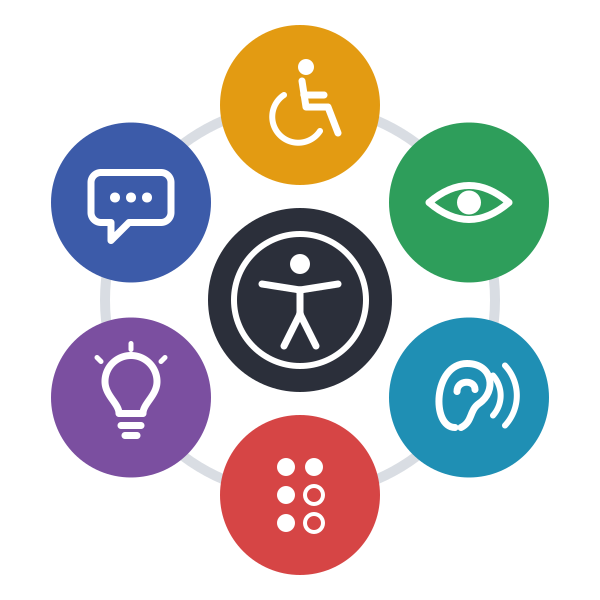
Digital accessibility means that all people – regardless of visual, hearing, motor or cognitive impairments – can perceive, operate, understand and reliably use digital content (POUR: Perceivable, Operable, Understandable, Robust). The foundation worldwide is provided by WCAG 2.1, whose success criteria are divided into three levels of conformity (A, AA, AAA). In Germany, these requirements are binding through BITV 2.0 and the EU Directive 2016/2102, especially for public sector organizations. Consistent implementation not only improves participation but also increases usability, reach and legal certainty of digital services.
What does the law say?
At European level, Directive (EU) 2016/2102 requires all public sector bodies to make their websites and apps accessible. This includes, among others, administrations, universities and public hospitals, which must ensure that their digital services can be used by people with disabilities. Only public broadcasters and, in some cases, schools, kindergartens and nurseries are exempt. Germany has transferred these requirements into national law through implementing legislation.
Another important milestone is the Accessibility Strengthening Act (BFSG): From June 28, 2025, it will significantly expand the obligation for digital accessibility to the private sector for the first time. Those affected include, for example:
Online shops and marketplaces
Operators of e-commerce platforms must ensure that all purchasing processes – from product search to payment – can also be completed using a keyboard, screen reader or voice output. This includes clear alternative texts for product images, accessible PDF invoices, high-contrast color designs and understandable error messages in forms. Only this enables people with visual or motor impairments to shop online independently.
Operating systems and software platforms
Manufacturers of desktop, mobile and embedded operating systems as well as cloud services are required to support assistive technologies such as screen magnification, screen reader interfaces, subtitles or voice control from the beginning. A consistent, keyboard-operable user interface and documented interfaces for assistive technologies ensure that people with different disabilities can use any device.
Banking services including ATMs
Banks must design their online portals, mobile banking apps and ATMs so that they can be used without visual feedback or with limited motor abilities. Touch and voice output functions, clear focus sequences, sufficient color contrast and understandable TAN procedures are key requirements for enabling independent banking for all customers.
Electronic communication services
Telecommunications providers, messenger services and video conferencing systems must provide accessible customer portals, apps and contract information. Subtitle options, real-time text (RTT), compatibility with sign language interpretation services and accessible hotline channels ensure that people with hearing or speech impairments can also communicate without restrictions.
Access to audiovisual media
Streaming services, media libraries and set-top box manufacturers must provide user interfaces, player controls and content that can be used with screen readers, keyboards and switch controls. Legally required features include optional subtitles, audio descriptions, high-contrast menus and the ability to easily select alternative audio tracks.
Digital reading media such as e-books
Publishers and platforms offering e-books or digital magazines must provide content in reflowable and screen-reader-friendly formats (e.g. EPUB 3). Images, formulas and diagrams require meaningful alternative texts; reading apps need functions for adjusting fonts and contrast as well as support for screen readers and Braille displays.
Passenger transport and ticketing services
Transport companies – from rail and bus operators to airlines – must make timetable and booking portals, apps, ticket machines and check-in devices accessible. This includes step-by-step instructions in easy language, keyboard and voice output support, visually clear seat reservations and accessible self-service check-in at ticket machines.
As an internet agency with proven accessibility expertise, we recommend that affected companies take action now! Let us conduct a systematic audit of your websites, apps and self-service terminals to make all barriers transparent.
Based on these findings, we develop a realistic action plan together with you, including budget, resource and timeline calculations. Companies that set the course towards accessibility today avoid expensive last-minute solutions shortly before legal deadlines, improve usability and reach at the same time, and position themselves visibly as a responsible and inclusive brand.
Facts & Figures
1.3 Billion People
16% of the global population lives with a disability – a huge group of users who expect accessible websites.
7.9 Million People
In Germany, around 9.3% of the population depends on accessible websites.
Ø 51 Errors/Homepage
Currently, at least 96% of websites contain a critical WCAG violation and are therefore not accessible.
When does my website need to be accessible?
For public websites
All publicly accessible websites launched after September 2018 had to become accessible by September 2019 at the latest; older websites had until September 2020. The same requirements subsequently apply to intranet pages, apps and PDF documents.
For commercial websites
The Accessibility Strengthening Act (BFSG) comes into force on June 28, 2025. From this date onwards, websites of private companies and all related online services must also be designed to be consistently and demonstrably accessible.

Benefits for Companies
SEO Boost: Accessible websites have a clean structure – search engines can find content faster and rank it higher.
Conversion Advantage: When all users can reach their goals without barriers, completion and purchase rates measurably increase.
Positive Brand Perception: Inclusive websites demonstrate social responsibility and strengthen trust in your brand.
Legal Security: Compliance with legal requirements minimizes the risk of warnings, legal claims and penalties.
Larger Customer Base: By removing digital barriers, companies provide people with disabilities and older users with equal access to their services.
Get Started!FAQ
What does digital accessibility mean?
Digital accessibility means that websites, apps and digital documents can be used by all people – regardless of disability, age or technical ability – without additional assistance. In Europe, it is based on the EN 301 549 standard and the WCAG guidelines. (Source)
Which companies are covered by the Accessibility Strengthening Act (BFSG) from June 28, 2025?
The BFSG applies to all companies that sell digital services or products (e.g. online shops, e-books, ticketing and banking apps) to consumers. Micro-enterprises with fewer than 10 employees may be partially exempt. The deadline for implementation is June 28, 2025. (Source)
Who is affected by the Accessibility Strengthening Act?
Affected are providers who fall under Section 3 of the BFSG: e-commerce platforms, banking and payment services, transport service providers, e-readers and many more. Services that are provided exclusively B2B or within a closed user group may fall outside the scope of the law. (Source)
What does BITV stand for and what does BITV 2.0 regulate?
BITV stands for Accessibility Information Technology Regulation. The current version – BITV 2.0 – has applied since May 25, 2019, to websites, apps, intranets and digital administrative processes of federal public authorities. It refers to the harmonised standard (currently EN 301 549 V3.2.1) and requires an accessibility statement as well as a feedback mechanism. (Source)
What is the difference between BITV 2.0 and WCAG 2.1/2.2?
WCAG are international guidelines issued by the W3C; BITV 2.0 is German legislation for the public sector and refers to WCAG-based standards. In short: WCAG defines what accessibility means, while BITV 2.0 defines who must implement it legally in Germany. (Source)
What is a BIK-BITV test and how does it work?
The BIK-BITV test is a standardised audit consisting of 90 test steps based on WCAG 2.1/2.2. Testers select representative pages, perform manual checks and tests with assistive technologies, and create a detailed report with an optional certification seal. (Source)
How much does a BITV test or accessibility audit cost?
The costs depend on scope and complexity. Typical ranges are: €1,500–€8,000 for standard websites, €8,000–€20,000 for complex web applications; smaller projects start at around €1,000. (Source)
How do I make my website accessible?
1. Audit (BITV/WCAG test) → 2. Action plan → 3. Technical and editorial implementation (HTML structure, semantics, contrasts, alternative texts, keyboard navigation, ARIA) → 4. User testing with assistive technologies → 5. Publish accessibility statement and feedback mechanism.
What requirements must my website meet by 2025?
Public authorities: full BITV 2.0 compliance including accessibility statement and feedback form. Private providers within the scope of the BFSG: accessible design according to EN 301 549 / WCAG 2.1 AA and provision of accessible consumer information. (Source)
What consequences can occur if accessibility requirements are not met?
Supervisory authorities can issue deficiency reports, enforcement orders and fines; public pressure and exclusion from public contracts are common consequences. (BFSG: fines of up to €100,000; BITV 2.0: objections and deadlines for remediation).
How does your agency specifically support us?
Our agency provides comprehensive support on your journey towards an accessible website – from the initial analysis through continuous quality monitoring. We begin with a WCAG/BITV audit, systematically reviewing all pages and functions and creating a prioritised roadmap for necessary improvements. Afterwards, we develop or optimise your UX/UI design, create an AA-compliant component library in Figma and implement the solution technically, whether as static HTML, within a content management system or in your web application. At the same time, we prepare the legally required accessibility statement and all BFSG documentation, ensuring that you remain legally compliant. Finally, we train your team in accessible workflows and establish monitoring that automatically checks future updates for accessibility – ensuring your digital products remain accessible in the long term.
Your accessibility contact person
Bastian Kretzschmar
Dipl. math. oec., Managing Director
Phone: 0049-89-700742-660 Phone:0049-89-700742-660