


Semantic HTML plays a crucial role in the development of modern websites. It is about presenting the content of a website in a meaningful and structured way. But what exactly does semantic HTML mean?
Basics of Semantic HTML:
The importance of semantic HTML lies in the fact that it improves the readability and accessibility of websites. By structuring our code with semantic elements, we provide browsers and search engines with valuable information about the content of our website.
A typical example of semantic HTML is the use of headings. Instead of simply displaying text in a larger and bold font, we use the appropriate heading tags, such as h1 through h6. This allows search engines to better understand the structure of our page and also makes navigation easier for users with visual impairments.
Another important semantic element is the "article" tag. With this tag, we identify individual parts of our website that can be considered independent, self-contained content. This makes it easier for search engines to identify and display relevant information.
The "nav" tag is another good example of semantic HTML. It allows us to clearly define the navigation of our website. This improves the user experience and makes it easier for visitors to find their way around the page.
In addition to these examples, there are many other semantic HTML elements such as "section", "footer", "aside", and "header", to name just a few. Each of these elements has a specific meaning and serves to structure content clearly.
Benefits of Semantic HTML:
One of the greatest benefits of semantic HTML is that search engines can better understand the content of a website. By using specific tags, the content of a page is defined more clearly and precisely. Search engines such as Google can therefore index the website more easily and provide more relevant search results. Ultimately, this leads to greater visibility and better rankings in search results.
Semantic HTML also improves the accessibility of a website. Well-structured and semantically correct code enables people with visual impairments or other disabilities to better understand the content of a website. Screen readers and other assistive technologies can interpret semantically structured code more easily and read or display the content accordingly.
Another advantage of semantic HTML is that it is easier to maintain and update. By using specific tags, it is easier to structure and organize the content of a website. Changes or updates can therefore be made more quickly and efficiently while preserving the semantic structure of the code.
Examples of Semantic HTML in Practice:
One example is the use of HTML elements such as < article >, < section >, and < aside >. These help divide the content of a website into logical sections. The < article > element is used to mark self-contained content such as blog posts or news articles, while < section > is used for larger thematic sections. The < aside > element can be used to provide additional information or supplementary content.
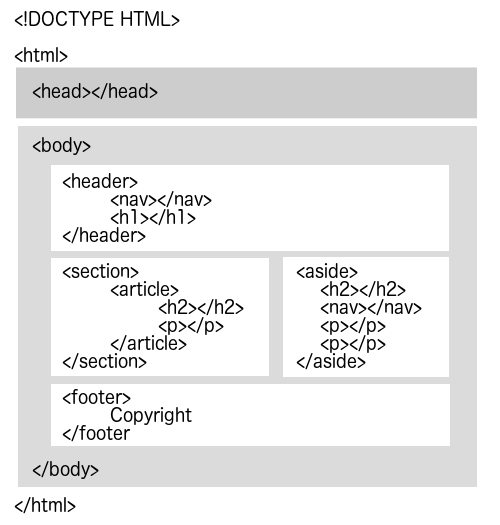
Image source: https://dev-grades.de/Development/html_struktur.html
The semantic markup of tables is also very important. Instead of simply using < table >, < thead >, < tbody >, and < tfoot > should be used to structure the header, body, and footer of a table. This not only makes styling and design easier, but also enables users of assistive technologies to better understand the content of the table.
Our Internet Agency Munich, Econcess, places great emphasis on engaging design to appeal to a wide range of customers. If you are interested in a website for your company, please feel free to contact us. We specialize in customized solutions and offer professional support in the implementation of your digital projects.