

A domain is the address people use to visit a website. It is a globally unique and unambiguous name or address under which users can access content on the Internet or a network. It is an essential part of the Uniform Resource Locator (URL) and specifies where the corresponding resource can be found within the hierarchical structure. Internet domains can, for example, look like this: www.beispiel.de.
How is a domain structured?
A domain is divided into different parts. First, it is necessary to define exactly what the domain name is in order to understand its precise structure. In connection with Internet addresses, the two terms URL and FQDN play an important role.
Uniform Resource Locator (URL)
The URL is an exact identifier that includes both a resource and the access method used to retrieve it. The best-known form is: https://www.beispiel.de. This refers to a website that is accessed through a browser.
Fully Qualified Domain Name (FQDN)
The term FQDN is used for the complete name of a domain. It specifies the exact position of a target computer within the hierarchy of the Domain Name System and consists of two parts: the host name and the domain name. An example would be: Mailserver.beispiel.com. While Mailserver represents the host name, beispiel.com specifies the domain.
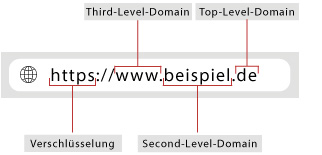
Top-Level Domain (Domain Extension)
Top-level domains (TLDs) represent the highest level of name resolution in the hierarchy of the Domain Name System and always appear as the final component of a web address. They are therefore also referred to as domain extensions.
Second-Level Domain (Domain Name)
The Second-Level Domain is the freely selectable name below any Top-Level Domain. It is also referred to as the domain name and is significantly more important than the domain extension from both a user and SEO perspective, as it can better describe the content of a page and can even contain keywords.
Third-Level Domain (Subdomain)
An additional domain level can optionally be placed below the domain name. This type of domain is positioned before the Second-Level Domain and is referred to as a Third-Level Domain or subdomain. The name of the subdomain is placed before the domain name (Top-Level Domain) and separated from it by a dot. It provides large companies or highly structured websites with an opportunity for logical organization and separation.
Encryption (Protocol)

HTTPS (Hyper Text Transfer Protocol Secure) can be used to transmit data over the Internet between the client (web browser) and the server. This protocol establishes a secure connection between the browser and the server. The data is now encrypted in both directions and can no longer be easily manipulated or copied.
A domain is the address people use to visit a website. It is a globally unique and unambiguous name or address under which users can access content on the Internet or a network. It is an essential part of the Uniform Resource Locator (URL) and specifies where the corresponding resource can be found within the hierarchical structure. Internet domains can look like this: www.beispiel.de.
Do you have any further questions about this topic? Or do you need help designing your website from a professional web agency in Munich? Then feel free to contact us!