


To represent colors in digital media and in print, two systems are primarily used: RGB and CMYK. The color spaces of RGB and CMYK do not completely overlap. This means that not all RGB colors can be printed, and not all print colors created with CMYK can be displayed on digital screens.
Screen Colors - RGB
RGB is the color space formed by the colors red, green and blue. These are the primary colors of additive color mixing. The colors are referred to as “light colors” and cannot be reproduced in print because mixing these three colors on printed materials is not possible.
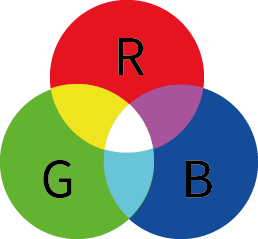
What are light colors?
Light colors are colors emitted by a light source. The mixing of light colors is called additive color mixing because the different wavelengths of light are added together. In additive color mixing, white is produced as the sum of all primary colors.
sRGB and CIE-RGB
The RGB system is used by technical devices such as monitors, televisions and smartphones to produce colors. The standard RGB color space sRGB is supported by many hardware and software manufacturers, including Adobe and Nikon. CIE-RGB encompasses a larger RGB color space and therefore cannot be displayed on all devices.
Print Colors – CMYK
CMYK represents the primary colors of subtractive color mixing. These primary colors are known as body colors or pigment colors and consist of Cyan (light blue), Magenta (“Telekom red”), Yellow and Contrast/Key (Black). Offset printing uses these four colors.
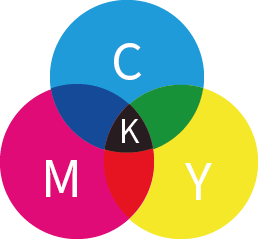
What are body colors?
Body colors are colors reflected by an object. The mixing of body colors is called subtractive color mixing because light is subtracted/absorbed. Together, they result in black. Body colors are not only used for printing presses, but generally refer to surface colors such as paints or emulsion paints.
Color Printing
In standard color printing, all colors are composed of the primary colors of subtractive color mixing, which are printed on top of one another using a halftone process. Following the “paint box principle,” colors mixed in specific proportions produce different hues. This is why it is referred to as four-color printing in CMYK color mode. In order to produce colors that are as pure as possible in color printing, chromatic or achromatic color separation is important. A maximum of three primary colors produces a distinct mixed color.
The CMYK color model is therefore a subtractive color model that forms the technical basis for modern four-color printing. Like RGB color spaces, CMYK color spaces are device-dependent and therefore require color profiles to describe hues accurately.