

Human-Centered Design initially sounds like a convincing ideal: solutions are developed with people's needs, goals, and expectations at the center. In practice, however – especially in companies – this ideal cannot always be fully implemented.
Numerous studies have already examined how Human-Centered Design can be permanently integrated into organizations. They repeatedly show that its implementation comes with various challenges.
This leads to another question: Does every project really need to follow a Human-Centered Design process? And how realistic is this, especially for small companies, start-ups, or agencies with limited resources?
How does the Human-Centered Design process work?
In theory, Human-Centered Design is divided into four main steps: understanding the context of use, defining user requirements, developing design solutions, and evaluating design solutions. It is important to understand that these steps do not necessarily have to follow a strict order. The process is iterative. This means that individual steps can be repeated and designers can return to an earlier step depending on new findings.
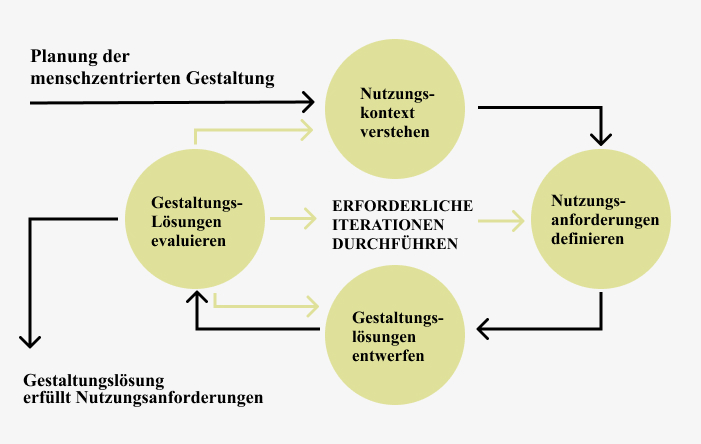
1. Understanding the context of use
The first step is to understand the context in which users interact with a website or a specific function. This could be the checkout, online payment, the shopping cart, or another interaction within a website. Designers consider questions such as: Who are the users? What do they want to achieve? Where, when, and how do they use the application? To answer these questions, methods such as target group research, user analysis, market research, interviews, or direct contact with users can be used. The goal is to understand as precisely as possible who the design is intended for and in which context the respective solution needs to work.
2. Defining user requirements
Once the context of use has been understood, concrete requirements need to be derived from it. It should be clear what users want to achieve and which needs have to be considered in the design. The insights gained beforehand are therefore translated into specific user requirements. Based on this foundation, the actual design process can begin.
3. Developing design solutions
The third step is where the creative design process begins. Based on the previously identified needs and requirements, initial solutions are developed. These may include initial concepts, wireframes, prototypes, or specific designs. The design should not be based solely on the designer's personal assumptions, but as much as possible on the insights previously gained about the users and their context of use.
4. Evaluating design solutions
The developed solutions then need to be evaluated. It is not enough to create a solution and simply assume that it works for users. This is why methods such as user testing or usability testing are used. These methods help determine whether the developed solution actually meets users' needs, whether it is understandable, and whether users can achieve their goals with it. At the same time, feedback is collected, which can lead to further changes in the design.
This is where the iterative nature of Human-Centered Design becomes particularly clear. If new problems or needs become visible during the evaluation, individual steps can be repeated. A concept can be adjusted, tested again, and revised if necessary. The process is repeated for as long as the respective project requires.
The challenges begin in everyday business practice
In theory, this process sounds logical and clearly structured. In practice, however, difficulties can arise quickly, especially in small companies or agencies where there may only be a single designer or a very small design team.
A single designer can hardly carry out a comprehensive Human-Centered Design process in isolation. They depend on the support of other areas, such as management, development, project management, and sometimes sales or marketing. Clients themselves also play an important role. Designers and developers need to work closely together, resources need to be available, users need to be accessible, and decisions need to be made at the right time. In addition, there are the typical limitations of everyday project work: limited budgets, time pressure, deadlines, technical dependencies, and client requirements. A designer may still be in the first phase and want to better understand the context of use, while the client already expects results or the developers have already started the technical implementation. This is exactly where the theoretically structured HCD process meets the reality of a project.
Human-Centered Design requires organizational support
This highlights an important aspect: Human-Centered Design is not solely the responsibility of a designer. For a user-centered process to work, the necessary conditions need to exist within the company.
Management must be willing to provide time and resources. Developers should be involved as early as possible, and clients also need to be willing to support analysis, research, or evaluation phases. Human-Centered Design therefore becomes not only a design issue but also an organizational one.
This is particularly relevant in smaller companies, where fewer resources are often available and individual employees may take on several responsibilities at the same time. As a result, a theoretically complete HCD process can quickly reach practical limits.
Does every project therefore need to be fully Human-Centered?
This brings us back to the question from the beginning: Does every project really need a complete Human-Centered Design process? In my opinion, no. It depends on the individual project.
For a new client, a user-centered approach can be particularly useful. Goals, user groups, and requirements can be defined together from the very beginning. The situation may be different for smaller projects or long-term client relationships. If an agency has been working with a client for many years, already knows the product, target group, and requirements well, and only minor changes need to be implemented, a complete HCD process is not always necessary.
The key question is therefore not whether every project is implemented entirely according to HCD, but how much Human-Centered Design is appropriate for the respective project.