



B2B decision-makers no longer just look through lists of links; they ask language models for precise answers. We optimise your content, entities and data structures so that modern AI engines name your brand as the leading recommendation. Our goal: visibility that does not just earn clicks – but gets cited.
Case studies


Why classic SEO alone is no longer enough
Classic optimisation relies on keyword density and clicks on ten blue links. With Google AI Overviews, Perplexity and ChatGPT Search, however, B2B buyers get their answers directly in the interface. If your brand has no verified entity in these syntheses, you fall out of the research process.
The zero-click reality: search queries are answered directly
More and more queries end without a click on a website because language models synthesise the solution directly. If your USPs are not extracted as a primary source, your offering simply does not feature in the final purchasing decision.
Missing semantic data structure for AI crawlers
Crawlers such as GPTBot or PerplexityBot skim unstructured body text. Without Schema.org JSON-LD, a clean semantic HTML5 structure and facts in tables, algorithms cannot store your expertise as a citable truth.
No brand entity: the algorithm recommends your competitors
AI engines rely on knowledge graphs. If consistent co-occurrences and trust signals for your brand are missing there, the LLM automatically falls back on established competitors when comparing products and service providers.
No transparency about generative mentions
Classic ranking tools do not capture chat dialogues. Without targeted prompt monitoring, you cannot see for which industry prompts your company is mentioned, misrepresented or ignored altogether.
Our framework: the 4 pillars of AEO & GEO
We transform your digital presence from pure keyword optimisation into a citable source of knowledge for modern AI systems. Our 4-pillar model fits together seamlessly:
Answer-Ready
Content & promptability: We structure your content into clear definitions, question-and-answer patterns and use cases that language models can extract and deliver one-to-one as a sourced answer.
Semantics
Data & llms.txt: Full integration of Schema.org (Organization, Service, FAQ) and provision of a machine-readable llms.txt file as a curated fact sheet for AI crawlers.
Authority
Entities & trust: Sharpening your brand entity in the digital knowledge graph through targeted co-occurrences, specialist sources, registry data and relevant mentions across the web.
Tracking
Prompt & citation audit: Ongoing monitoring across standardised B2B prompt clusters: for which queries is your brand cited, and what sentiment does the AI convey?
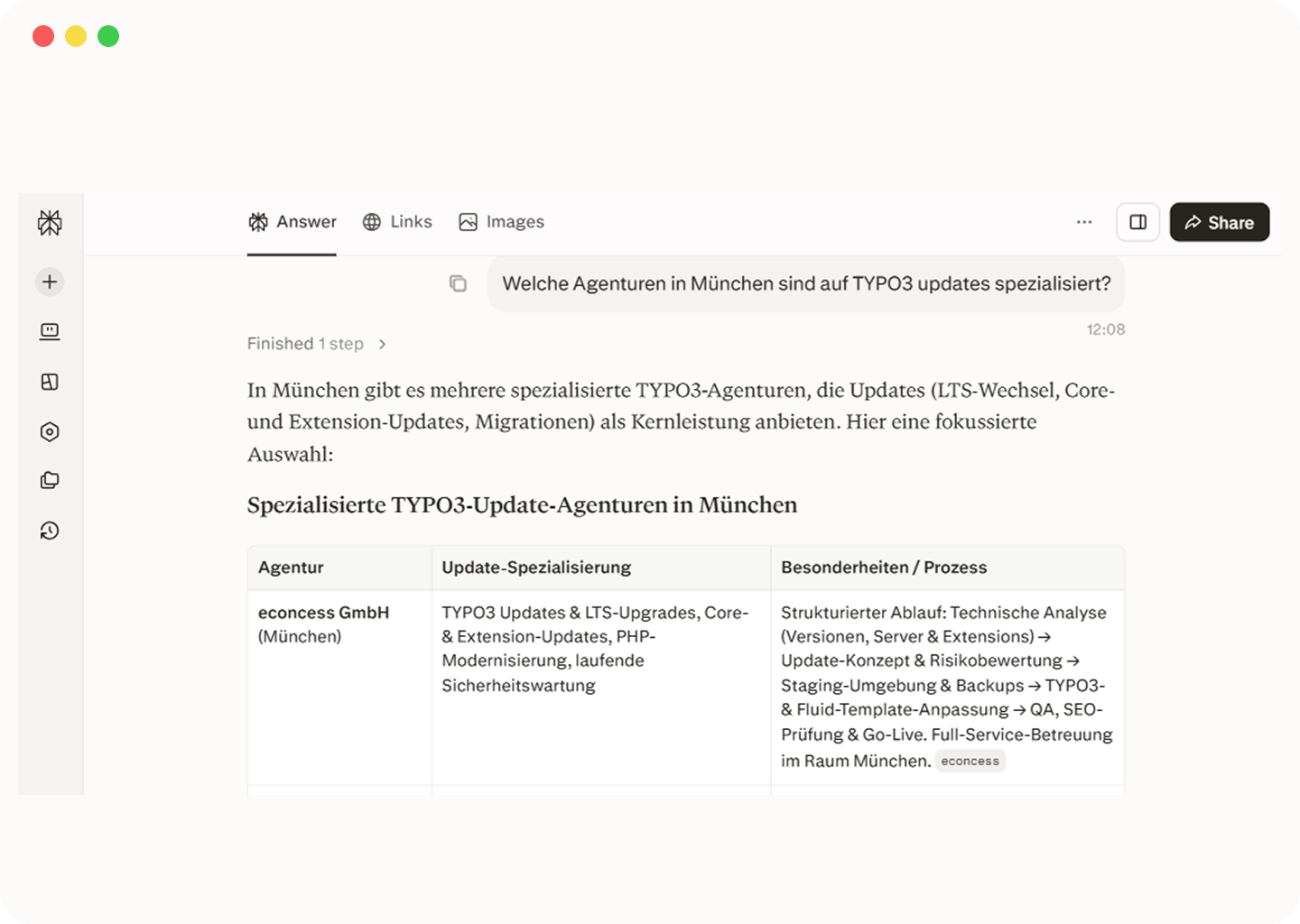
Our AI SEO & GEO services
- AI visibility audit: analysis of how your brand is currently mentioned in ChatGPT, Perplexity & Copilot
- Entity & knowledge graph optimisation: anchoring your brand entity in relevant data networks
- Semantic Schema.org integration: machine-readable data architecture for enterprise websites
- Content transformation: creating answer-ready content with high information gain
- llms.txt provision: configuration & maintenance of modern Markdown files for AI crawlers
- Prompt monitoring: regular tracking of industry prompts and competitor analyses
Technical integration & CMS expertise
We do not force you into a new CMS straitjacket. We integrate our technical AEO and GEO measures directly into your existing system landscape – with the highest standards of performance, accessibility and data security.
FAQ – Frequently asked questions about AI SEO & GEO
What is the difference between classic SEO, GEO and AEO?
Classic SEO optimises for search engine results pages (SERPs) and clicks on blue links. GEO (Generative Engine Optimization) and AEO (Answer Engine Optimization) prepare content so that language models and AI search engines (such as ChatGPT, Perplexity or Google AI Overviews) process your facts directly, summarise them as an answer and cite your brand as the source.
Do we still need classic SEO if we do GEO?
Yes. GEO does not replace SEO; it builds on it. Most AI engines use existing web indexes as the basis for their retrieval. A clean technical foundation, fast loading times and basic indexability remain the prerequisite for AI crawlers to consider your content at all.
How quickly do measurable results show up in ChatGPT or Perplexity?
While classic SEO re-evaluations often take months, AI engines with live web access often pick up structured data, semantic facts and answer-ready content within a few days to weeks of the next crawl.
What exactly does an llms.txt file do for our website?
Much like a robots.txt, an llms.txt serves as a standardised guide specifically for AI crawlers. It summarises your core offerings, key features and documentation in lean Markdown – without distracting HTML clutter or navigation noise.
How can success in AI answers be measured?
We use standardised test prompts for your industry and continuously monitor via APIs and monitoring tools how often and in what context your company is listed as a citation, source or primary recommendation.
What is the best way to get started?
In a 15-minute live audit, we test your current core services directly in leading AI engines (Perplexity, ChatGPT, Copilot) and show you concrete quick wins for becoming citable. Let's talk about it.
Your contact for AI SEO & GEO
Bastian Kretzschmar
Dipl.-Math. oec., Managing Director
Phone: +49 89 700742-660 Phone:+49 89 700742-660